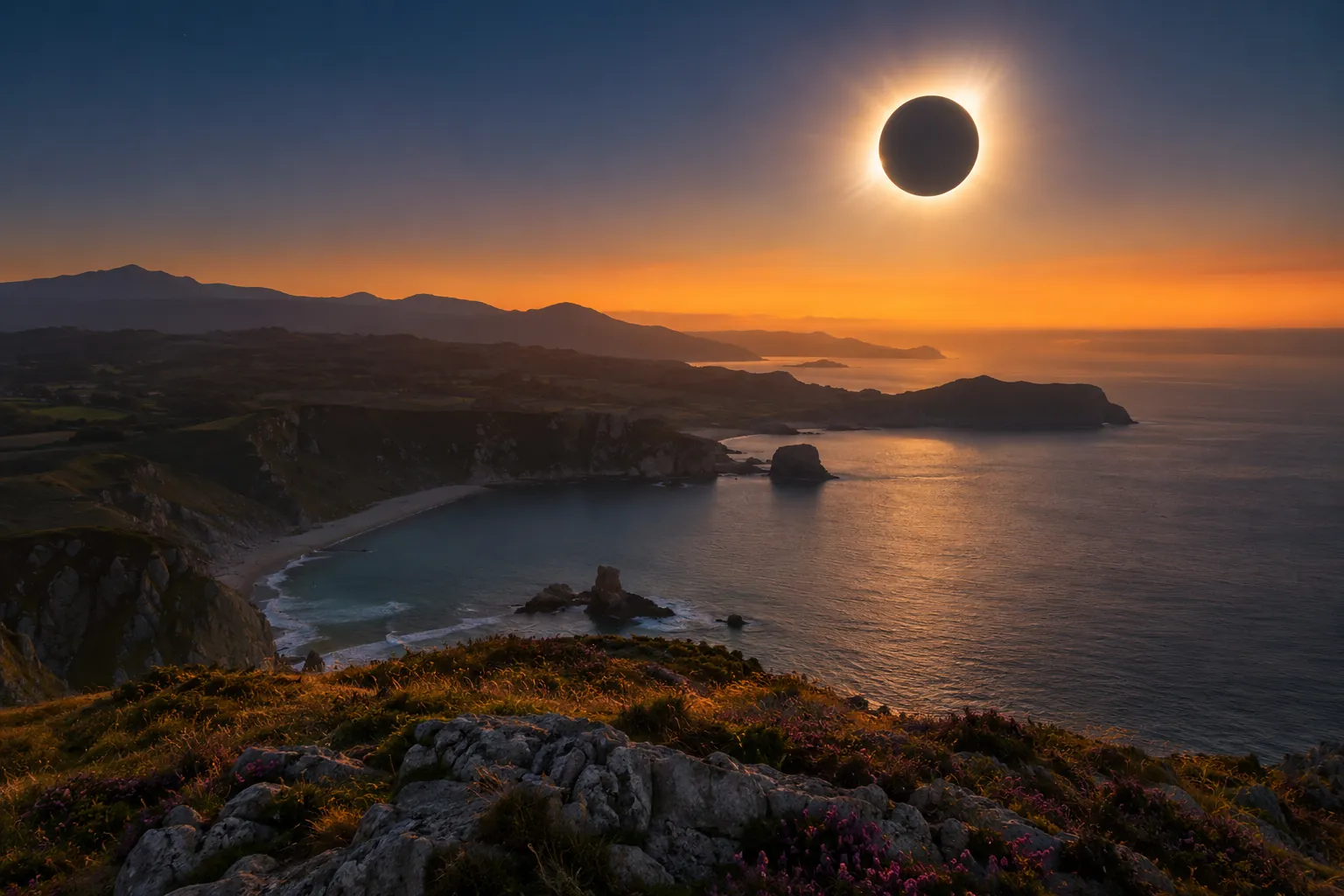
If you look up at the sky next summer, you will be part of history — twice. On 12 August 2026, Spain saw its first total solar eclipse in more than a century. And barely twelve months later, on 2 August 2027, the Moon will do it again, this time turning day into night right over our home ground: Cádiz and Tarifa, in the far south of Andalucía. Two chances, one region, and we happen to live exactly where the second one will be at its very best.
At Hidden in Spain we have been organizing tailor made trips through Spain and Portugal for many years, and we could not let this pass without preparing something special for it. But first, let's talk about what is actually going to happen.
2026: a preview, at sunset
The 2026 eclipse crossed the Arctic, Greenland, Iceland and then reached the Iberian Peninsula from the west, sweeping through Galicia, Asturias, the Basque Country, Aragón, Valencia and the Balearic Islands, more or less along the northern half of the country. It happened in the last hour before sunset, with totality lasting only around 1 minute 40 seconds in the best spots. In the south, including Cádiz, it was only a partial eclipse, a deep one, but not total. Think of it as the trailer of the real film.
2027: the big one, and it happens here
This is the eclipse eclipse hunters all over the world are already marking on their calendars. Experts are calling it possibly the "eclipse of the century" because of how long totality lasts and how many people live along its path. The Moon will be closer to Earth than usual that day, which makes its shadow wider and slower, so darkness stays longer than normal, over six minutes in some places on the planet.
The path crosses North Africa and the Mediterranean, and touches Europe only in one place: the southern coast of Spain. That means Cádiz province is, quite literally, Europe's front row seat.
- Tarifa: totality of about 4 minutes 39 seconds, one of the longest points anywhere along the whole path, and the longest in continental Europe.
- Cádiz city: around 2 minutes 51 seconds of totality, with the Atlantic and the old town as a backdrop.
- Gibraltar, just next door: about 4 minutes 25 seconds.
To compare, the famous 2024 total eclipse over North America lasted at best 4 minutes 28 seconds. Tarifa will beat it.
The eclipse begins mid-morning here, around 10:45 CEST, with the sun still fairly high (about 37º), so no need to fight against hills or buildings on the horizon like in the 2026 sunset eclipse. Good news for photographers, and for astronomers.
Q&A: what people are asking us
Do I need special glasses? Yes, always, except for the very short seconds of full totality, when the sun is 100% covered and it is actually safe to look with naked eye. Before and after that moment, certified eclipse glasses are a must. We will provide them.
Will it get dark like at night? Almost. The temperature drops noticeably (locals in Tarifa already joke it will feel like the levante wind arrived early), birds go quiet, and on a clear day you can even see planets and bright stars for those few minutes. In a place with as much open sky as the Strait of Gibraltar, the effect is dramatic.
Why is Tarifa so good for this, apart from the eclipse? Because it is one of those places that only make sense once you are actually there. It sits on the very southern tip of continental Europe, closer to Africa than to Madrid in every sense, and locals have known this for centuries.
Is it true you can see Africa from there? Yes, and not as a small silhouette in the distance. From Tarifa, Morocco is only about 14 km away across the Strait, so close that on clear days you can make out the mountains, and at night, the lights of Tangier. Many people don't believe this until they see it with their own eyes.
Things only someone from around here would tell you
- Tarifa is not famous first for tourism, it is famous among windsurfers and kitesurfers as one of the best spots in the world, thanks to the two winds that rule this coast: the levante (from the east) and the poniente (from the west). Locals read the wind the way sailors read the tide.
- Right next to Tarifa lies Baelo Claudia, an entire Roman city from the 2nd century BC, with its own theatre, forum and fish-salting factories, sitting almost on the beach. Few visitors expect ruins this complete this close to the sand.
- The Battle of Trafalgar, one of the most famous naval battles in history (1805, Nelson against the combined Spanish and French fleets), took place just off this coast, near Cape Trafalgar, a name most people only know from a British point of view, but that belongs to this very stretch of sea.
- The tuna here is not a random product, it is a tradition. The almadraba, an ancient fishing technique used by the Phoenicians before the Romans even arrived, still traps red tuna migrating through the Strait every spring. Barbate and Zahara de los Atunes, both minutes from Tarifa, are considered by many chefs the best place on earth to eat bluefin tuna, and locals will proudly correct you if you call it "just tuna."
- The beaches here are different from the typical Costa del Sol image: long, wild, often empty even in summer, with white dunes (like Valdevaqueros) instead of concrete promenades.
- Sherry country (Jerez) is barely 45 minutes away, and a glass of chilled fino or manzanilla with fried fish is, for most Andalusians, non negotiable at lunch.
Our eclipse program: 3 days, one astronomer, one villa
We are not going to send you to a random field with a chair and some glasses. We have built a small, private program around this event for people who want to actually understand what they are watching and experience the region properly at the same time.
- A private villa for 4 people near Tarifa, with the kind of views over the Strait that make you understand why people fall in love with this coast.
- 3 days together with a professional astronomer, who will explain the science before the eclipse, help you choose and set up the best observation point, and guide the group during totality itself.
- Time built in for the things that make this trip more than "just" an eclipse: a tasting of local tuna, a walk through Baelo Claudia, and free time on the beach, because you are, after all, in one of the most beautiful corners of Andalucía.
- Small group, personal attention, and complete flexibility to adapt the days around the weather forecast, which our astronomer will be watching closely as the date gets near.
Spaces are limited, both because the villa only fits 4 people and because this stretch of coast will, quite fairly, be crowded with visitors from all over the world in August 2027. If you want to be here for what may be the best total solar eclipse most of us will ever see without leaving Europe, get in touch with us and we will put together the details together.
Hidden in Spain — tailor made journeys through Spain and Portugal.